
Dominik Szoboszlai spent ten thousand hours playing football as a child and he was not even allowed to call his parents from abroad
His father lost his own parents at fourteen, squandered his inheritance, and found himself homeless at twenty-one. Time and again, sport helped him earn money, only for gambling to take it away. Love offered him a lifeline, but his young wife was battling a severe autoimmune disease — rheumatoid arthritis — and when she miraculously became pregnant, doctors warned her not to keep the baby. The couple refused to give up. They accepted the risk — and it changed everything. On October 25, 2000, their son was born: Dominik Szoboszlai.
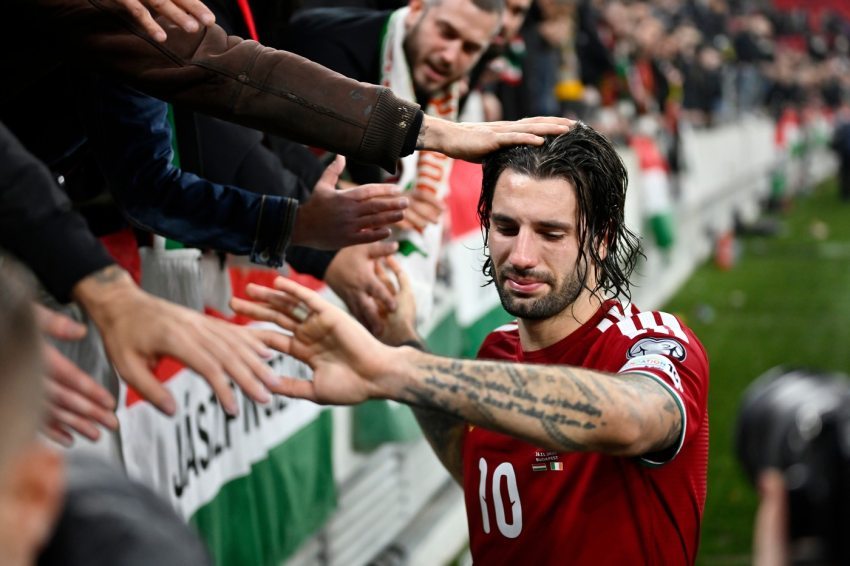
Some sports books list statistics and recycle anecdotes we have heard a thousand times before. Others — far more rarely — unfold deeply human stories with a level of honesty and depth we have never encountered before. The Szoboszlai Story belongs firmly in the latter category. It is a portrait of family and upbringing that remains gripping even for readers who know nothing about football and could not explain the difference between a false nine and a box-to-box midfielder.
Dominik Szoboszlai became a role model at a very young age because he proved that even from a prefabricated apartment block in Székesfehérvár, it is possible to reach the narrow elite of international sport and become a global star. This book is about him — but the spotlight is far from being on him alone.
Just as central is the figure of the father: the coach, the decision-maker, the doubter, the man shaping events from the background, often invisibly.
That man is Zsolt Szoboszlai, who, together with world champion pentathlete and renowned sports journalist Attila Kálnoki Kis, recounts his son’s journey from his own perspective.
His son’s journey — because after gambling, Zsolt became “addicted” to raising Dominik into a top footballer and in this high-stakes game, they ultimately both won. So did the entire family — Dominik later had a younger sister — and perhaps even Hungarian football itself.
Ten thousand hours: a family orbiting around the ball
Is there a recipe for success that can actually be shared? “It doesn’t matter whether you play piano, violin, climb walls, play handball or football — if you have the right basic abilities and spend ten thousand hours doing it between the ages of five and eighteen, you will become a master of that activity. Domi put in the ten thousand hours.”
His parents believed this deeply, and they built his life around it.
An average Hungarian child who dreams of becoming a professional footballer and trains regularly at club level may spend two or three thousand hours with a ball over ten years — often without realising that extra individual work is needed for true success. A particularly determined child might double that amount.
Dominik, however, played football five hours a day. Over ten years, the numbers added up to ten thousand.
To achieve this, he trained with multiple age groups every single day. He worked on Christmas Day and New Year’s Day. On family holidays too. The only time he stopped was when he was ill.
Then there were the seemingly “small” but highly consistent rules: chocolate, ice cream, even a PlayStation had to be earned through measurable football tasks completed with precision — against the clock or according to strict targets.
For Dominik, this was not a punishment. He was a willing partner in it, driven by competitiveness.
He also spent countless hours practising with a special football stitched together from three coloured panels, learning exactly which part of his foot should strike which coloured section in order to perfect different kicking techniques with geometric precision.
Talent alone is never enough
At fifteen, Dominik moved to Salzburg and began his professional life at the Red Bull Academy. Even then, his father’s approach to independence was anything but ordinary. “I’m not the emotional type,” Zsolt says in the book. “So whenever he called me with a problem, I listened and simply said: ‘Solve it. Call me back when you’ve done it.’” Then he turned to Zsani, Dominik’s mother: “If Domi calls, don’t answer. Don’t reply to his messages either. There’s nothing wrong with him — he’s just trying. Let’s grit our teeth and keep doing our jobs. We’ll call him back tonight, and then you can talk to him.”
In the extreme competitive environment of Salzburg’s elite football academy, only this kind of independence could keep Dominik afloat and eventually make him one of the very best. This episode also reveals what may be the book’s most sensitive and fascinating layer: the father–son relationship.
Zsolt does not idealise himself. He openly discusses mistakes, excessive strictness and moments of doubt. The question hangs over every chapter: can someone be both a loving parent and a relentlessly demanding coach?
The answers are far from black and white — and that ambiguity is precisely what makes the story compelling. The book neither excuses nor condemns. Instead, it leaves space for readers to draw their own conclusions. Perhaps seven or eight out of ten children would have collapsed under this parenting style. Dominik thrived in it.
The book’s greatest strength is its honesty. This is not a heroic myth. It is a detailed account of what it truly means to consciously build a child’s future in professional sport. Outsiders often see only the gifted talent who “naturally” rises to the top. But the book reveals the daily routines, sacrifices, conflicts — and the uncomfortable truth that talent alone is nowhere near enough.
Today, Dominik Szoboszlai captains the Hungarian national team, and it is entirely possible that he may soon hold a similarly defining role at Liverpool — unless a club like Real Madrid comes calling first. He is already the first Hungarian footballer to win the English Premier League, and it no longer feels unrealistic that he could one day become the first Hungarian to lift the Champions League trophy as well.
Where success is born
The book reveals the intense internal debates behind career decisions that now seem obvious in hindsight. It shows how Dominik — now a family man himself — became both one of the dressing room’s biggest characters and a responsible adult. Which coaches shaped him most. How he learned to move beyond pain, injury and failure.
Why he can appear overly confident, when in reality he simply cannot afford to show weakness in an environment that would “eat him alive for breakfast.”
How he handles the media and public recognition. Why he needs boundaries. What it is like when people no longer recognise only him — but his father too. How he manages the unimaginable sums of money he now earns. And what it truly means for him to wear the Hungarian national colours.
The Szoboszlai Story carries lessons and life strategies far beyond football. Even readers who have no interest in the sport will find it accessible, because the real focus is not on matches, but on the human processes unfolding behind the scenes. The book avoids the trap of manufacturing a legend or exploiting one further. Instead, it simply shows the road itself — with all its bumps and hardships. It offers a rare glimpse into the inner world of a family where success was born. And ultimately, this is not really a story about sport at all. It is about how a child becomes an authentic adult — whether under the floodlights or far away from them.
Attila Kálnoki Kis – Zsolt Szoboszlai: The Szoboszlai Story, Animus Publishing, 2025.
The English translation was produced with large language model and reviewed by a human editor.