
The exiled princess has returned home: after 700 years, the tomb cover of Blessed Elizabeth of the Árpád dynasty is back in Hungary
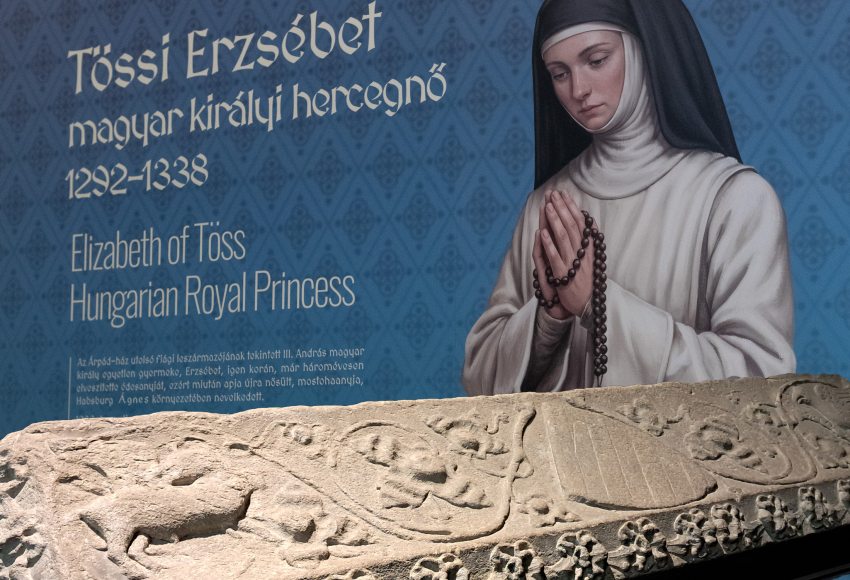
“The Last Golden Twig” – this is how some refer to Blessed Elizabeth of the Árpád dynasty, whom we Hungarians have somewhat forgotten. After the death of her father, King Andrew III, the last ruler of the Árpád line, in 1301, she was forbidden to ever set foot on Hungarian soil again. Elizabeth lived as a nun in the convent of Töss in Switzerland. After her death, miraculous healings were associated with her incorrupt body. Now, perhaps, she receives some form of reparation for her exile: after more than seven hundred years, she has, in a remarkable way, returned home. The richly carved lid of her sarcophagus has been brought from Switzerland to Székesfehérvár, to the Coronation Basilica Visitor Center — placed in sacred proximity to the sarcophagus of Saint Stephen.
Once upon a time, at the end of the 13th century, there lived a Hungarian princess. When she was born in the castle of Buda, legend says that her father, King Andrew III, was so overjoyed that he ordered the bells to be rung and wine to be distributed among the people of the city. The little girl was named Elizabeth, and no one could have foreseen that the last descendant of the Árpád dynasty would not fulfill her destiny in the splendor of a royal court, but in the silence of a convent in a foreign land. That, as Blessed Elizabeth of Töss, legends would arise about her life and the miraculous healings connected to her. This is how we could begin the tale — one that, after a mere 700 years, somehow finds everything falling back into place.
The last princess of the Árpád Dynasty
Elizabeth was the only daughter of King Andrew III of Hungary. With his reign, the three-hundred-year history of the Árpád dynasty came to an end — a dynasty whose kings had laid the foundations of the Hungarian Kingdom’s stability. Yet the princess experienced the cruelty of power struggles from an early age. Her mother, Fenenna of Poland, whom Andrew III married in December 1290, died young, leaving Elizabeth half-orphaned at barely three years old.
After her father remarried, Elizabeth was raised at the court of her stepmother, Agnes of Habsburg. When Andrew III died in 1301, Elizabeth was only eight years old. With the extinction of the male line of the Árpád dynasty, a chaotic period began in Hungary. Several European ruling houses competed for the throne, and the young princess became a pawn in political negotiations.
The king’s widow and Elizabeth were expelled from Hungary and were only released on the condition that they would never return to the kingdom.
On foreign soil
The princess was first taken to Vienna, and for years her life unfolded across various courts and convents. After Agnes of Habsburg herself entered religious life, she placed her stepdaughter in the Dominican convent of Töss, near Winterthur in present-day Switzerland. There is no exact record of when Elizabeth entered the order, but a 14th-century chronicle, The Book of the Sisters of Töss, written by the Dominican nun Elsbeth Stagel, describes her as follows: “Though she was of noble birth, she was even nobler through her virtues.”
According to records, Elizabeth was an exemplary, humble, diligent, and loving nun. She did not seek privileges because of her royal origin and took part in the daily work of the convent just like the other sisters. She showed particular compassion toward the poor and the homeless.
The homesick princess
The chronicles also reveal that Elizabeth carried homesickness in her heart throughout her life. She had been torn from Hungary as a child and never saw her homeland again. Living in the silence of the convent, she often spoke of the distant country where she was born. According to legend, this inner sorrow accompanied her throughout her life, along with significant physical suffering.
Convent records indicate that Elizabeth suffered from a mysterious illness that physicians could not explain. She was often bedridden for weeks or even months due to severe pain.
The chronicle states that “no such illness had been seen in all of Germany.”
In the last two years of her life, the princess could barely leave her sickroom. According to legend, she awaited death, which finally came on October 31, 1336. Elizabeth lived to be forty-two years old.

The legend of the incorrupt body
After her death, unusual stories began to circulate in the convent of Töss. According to accounts collected by the Swiss priest Robert Heinrich Oehninger, Elizabeth’s body—contrary to the custom of the order—was buried in a stone sarcophagus at the command of Queen Agnes of Habsburg. From her death in October 1336 until her reburial in 1337, her body remained incorrupt, showing no signs of decay, which the nuns regarded as a divine miracle.
The convent tradition also recorded several miraculous healings. One story tells of a nun who had been ill for a long time; she was brought to Elizabeth’s body, and after touching it with reverence, she was immediately healed. This event contributed to Elizabeth soon being venerated as “Blessed” within the Dominican order. This veneration is also reflected in the beautifully carved tomb monument erected for her in the sanctuary of the convent church.
In Winterthur, a street was named after the Árpád princess, and local children still learn about her life in school.
A unique tomb cover
Sadly, during the Reformation, the convent of Töss was devastated, and many medieval relics —including Elizabeth’s tomb — were destroyed. To this day, the location of her earthly remains is unknown. However, in a remarkable way, the beautifully carved, approximately half-ton lid of her tomb survived. It is the only sarcophagus lid connected to the Árpád dynasty that has remained intact.
The story of the princess was rediscovered by Michel Bakocs, a Zurich-born man of Hungarian descent and leader of the Hungarian Archery Club in Switzerland. In 2014, while stuck in traffic in Töss, he noticed a double cross on a red background in the district’s coat of arms. After a brief online search, he realized he was looking at the Hungarian apostolic double cross.
Members of the Hungarian community in Switzerland, led by Michel Bakocs and Szilvia Struhar, took action to restore Elizabeth’s memory to Hungarian public awareness. They translated Oehninger’s book into Hungarian under the title The Veil of the Crown Princess – The Legend of Blessed Elizabeth of the Árpád Dynasty (A koronahercegnő fátyla – Árpád-házi Boldog Erzsébet legendája). Over the years, they gathered more than fifteen thousand signatures from around the world to persuade the Swiss authorities that the tomb lid of the “Last Golden Twig” belongs in Hungary.
The initiative was supported by Hungary’s ambassador to Switzerland, József Czukor, and Tamás Vargha, a member of parliament from Székesfehérvár. Through their joint efforts, the Zurich National Museum agreed to loan the invaluable artifact to Hungary, specifically to the King Saint Stephen Museum in Székesfehérvár.
The sarcophagus lid, carved from gray limestone and once painted in vivid colors by Swiss craftsmen, is also a remarkable work of art from an art historical perspective. The triangular stone lid is richly decorated with plant tendrils, leaves, and floral motifs.
At its center are two coats of arms: one bearing the red and silver stripes of the Árpád dynasty, the other the apostolic double cross, symbolizing the Hungarian Kingdom and the Árpád lineage.
The edge of the lid is adorned with forty-two floral motifs — interpreted by some as representing the years of Elizabeth’s life.
A symbolic homecoming
Since March 7, the sarcophagus lid has been on display in Székesfehérvár, a city that for centuries served as the coronation and burial site of Hungarian kings. The tomb cover of Blessed Elizabeth is exhibited in the Coronation Basilica Visitor Center of the National Memorial Site, just a few meters from the fragment of the sarcophagus lid of King Saint Stephen. In this way, the beginning and the end of this remarkable ruling dynasty meet.
Although Blessed Elizabeth of the Árpád dynasty could never return to her homeland during her lifetime, her memory has now reached Hungarian soil. If not in life, then in remembrance, she has finally come home.
Blessed and Saint Elizabeth
In Hungary, we are primarily familiar with Saint Elizabeth of the Árpád dynasty, the daughter of King Andrew II, who lived in the 13th century. As a child, she was taken to Germany, as she had been betrothed to Louis IV, Landgrave of Thuringia, whom she later married happily and with whom she had three children. After her husband’s death, she gave away all her wealth to the poor, founded a hospital, and devoted her life to charity. She was later canonized by the Church.
She should not be confused with Blessed Elizabeth of the Árpád dynasty, who lived not as a queen, but as a nun in the convent of Töss in Switzerland.
The English translation was produced with large language model and reviewed by a human editor.